The Future of TV is Here: How Blue PHOLED and ZRIET Are Changing Everything
From Deuterium-enhanced blue emitters to 5-layer Penta-Tandem architectures, 2026 marks the turning point for OLED efficiency. Industry insiders break down the tech that's closing the gap on full phosphorescent displays.
Why Blue PHOLED Matters: The Efficiency Gap
OLED TVs deliver unparalleled picture quality - perfect blacks, infinite contrast, and colors that pop like nothing else. But there's a dirty secret hiding in every pixel.
Your current OLED TV is a hybrid. It uses two fundamentally different emitter technologies:
Red & Green: Phosphorescent (PHOLED)
Near-unity internal quantum efficiency (接近100%). These materials convert almost all electrical energy directly into photons. Developed and patented primarily by Universal Display Corporation (UDC).
Blue: Fluorescent (Legacy)
Only ~25% efficient - the remaining 75% becomes wasted thermal energy. This inefficiency is the primary reason OLED TVs run hotter and can't match the brightness of Mini-LED alternatives.
The Deuterium Breakthrough (2026)
The 2026 breakthrough in blue PHOLED stability comes from Deuterium-enhancement (replacing hydrogen atoms with heavy hydrogen). This significantly reduces molecular degradation - solving the infamous "Blue Decay" problem that has plagued blue phosphorescent emitters for over a decade. Companies like Lordin are leading this charge with Deuterium-doped host materials.
Why does this matter? Until blue PHOLED achieves commercial viability, the entire OLED industry is leaving approximately 40% of potential efficiency on the table. That's not just a number - it's the difference between a TV that runs cool and one that needs active cooling, between 1,500 nits of peak brightness and 3,000+.
The Science: How PHOLEDs Work
Understanding phosphorescence at the molecular level reveals why blue is so difficult - and why ZRIET represents such a breakthrough.
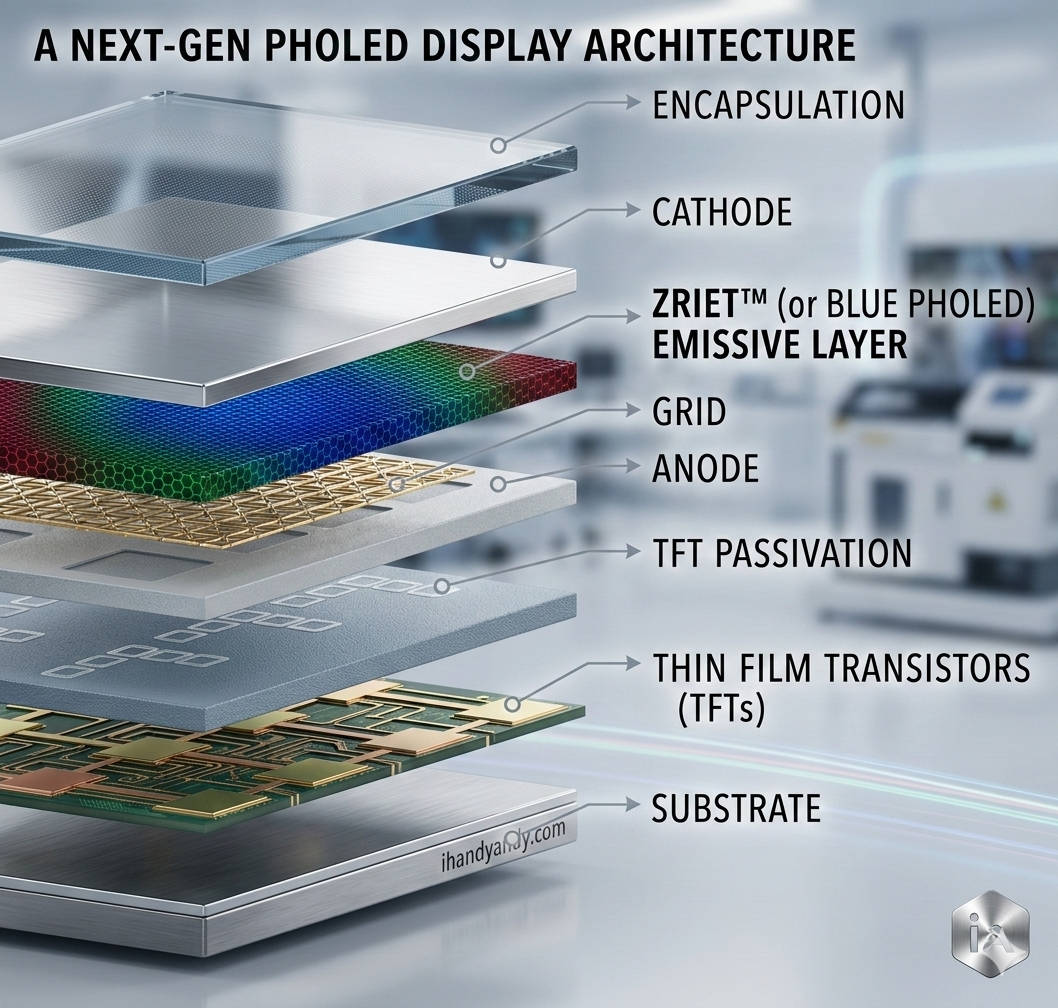
Left: PHOLED device architecture showing organic emissive layers between electrodes. Right: Emitter structure with host materials supporting phosphorescent dopants.
Electroluminescence Basics
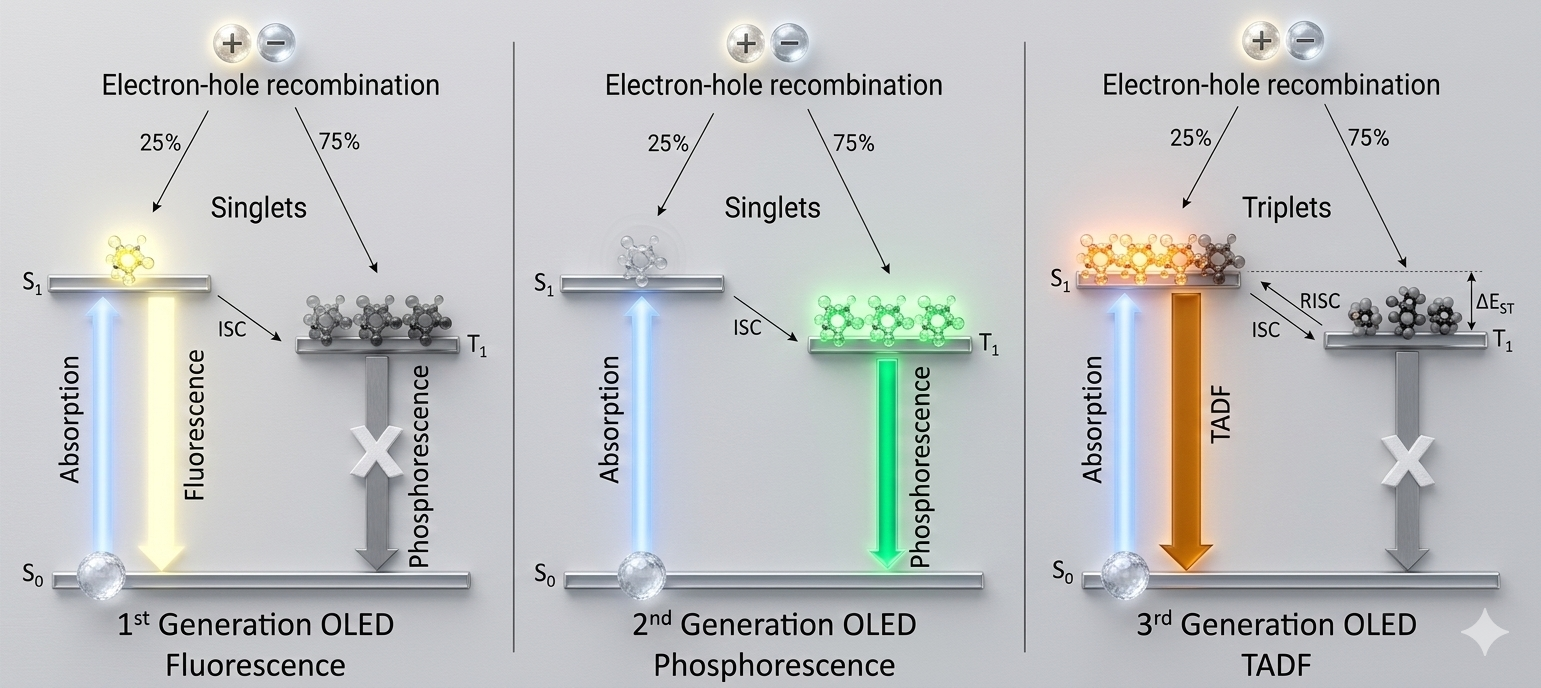
When electricity passes through an organic semiconductor layer, electrons and "holes" (positive charges) recombine to form excitons. These excitons then decay and release energy as photons - light. The color depends on the energy gap of the emitter material.
Singlet vs. Triplet States
Excitons form in two quantum states: singlets (25% probability) and triplets (75% probability). Fluorescent materials only harvest singlets - wasting 75% of available energy. Phosphorescent materials harvest ALL excitons by enabling "forbidden" triplet-to-ground transitions using heavy metal atoms.
What Does ZRIET Mean?
ZRIET stands for Zhongjing Rare Earth Inorganic Thin-film. This name reveals two key innovations:
- Rare Earth Elements: Instead of iridium-based phosphors (used in red/green PHOLEDs), ZRIET uses rare earth compounds (likely europium or cerium-based) that naturally emit blue light more efficiently
- Inorganic Framework: Unlike traditional organic PHOLED emitters, ZRIET's inorganic matrix provides exceptional thermal stability - critical for preventing the "Blue Decay" that has plagued previous blue phosphorescent attempts
- Zero-Radius Structure: Lordin's proprietary molecular design eliminates the spatial separation between host and dopant, maximizing energy transfer efficiency
Bottom line: ZRIET isn't just another incremental improvement - it's a fundamental reimagining of blue emission chemistry that could finally crack the 25% efficiency barrier that's held OLED back for two decades.
The 2026 Competitive Landscape
Three players, three very different approaches
Lordin & ZRIET: The Full PHOLED Path
This South Korean startup has developed ZRIET (Zhongjing Rare Earth Inorganic Thin-film) - a revolutionary blue phosphorescent material targeting true full phosphorescent emission.
Nerd Stats: Lordin's ZRIET targets EQE >20% with a 456nm deep blue emission wavelength. The key differentiator? A "Zero-Radius" molecular structure specifically engineered to bypass UDC's existing patent portfolio.
LG Display: The Tandem Strategy
Rather than chasing full PHOLED, LG's 2026 commercial strategy centers on Hybrid Tandem stacks - layering multiple phosphorescent and fluorescent emissive layers to achieve PHOLED-like brightness without waiting for blue PHOLED maturity.
Industry Insight: LG's Tandem architecture delivers ~30% higher brightness than single-stack OLED while maintaining a 10-year lifespan - a critical requirement for consumer TVs that pure blue PHOLED still can't guarantee.
Samsung Display: Penta-Tandem & the Brightness Wars
Samsung isn't sitting this out. Their Penta-Tandem architecture uses 5 stacked emissive layers to achieve jaw-dropping 4,500 nits peak brightness - directly challenging LG's dominance.
The IP War: Lordin's ZRIET uses rare earth compounds instead of traditional iridium-based phosphors - a deliberate choice to circumvent UDC's patent thicket. Expect legal battles as these technologies approach commercialization.
"We're watching three different futures for OLED unfold in real-time. The winner won't be decided in labs - it'll be decided in manufacturing yield rates." - Display Supply Chain Consultants, Q1 2026
What Full PHOLED Means for You
When blue PHOLED finally arrives, here's what changes
3,000+ Nit Peak Brightness
Full PHOLED enables brightness levels previously only achievable with Mini-LED. HDR content will look more dynamic than ever - especially in bright rooms.
Cooler Operation
40% less wasted energy means significantly less heat. No more warm OLED panels - and potentially smaller, thinner form factors.
True 10-Year Lifespan
Current OLEDs already age well, but blue PHOLED's Deuterium-enhanced stability eliminates the last remaining long-term concern - blue pixel degradation.
The Bottom Line
Here's the honest reality: Full blue PHOLED consumer TVs are likely 2-4 years away from mainstream availability. But the 2026 generation of Tandem OLED TVs - like the LG C6 and Samsung S95F - already deliver 70-80% of the promised benefits. You don't need to wait for the perfect TV when today's flagships are this good.
Wait or Buy in 2026?
Here's the updated reality for March 2026: Full blue PHOLED consumer TVs are realistically 2-4 years away from mainstream availability. However, the gap between now and then has never been smaller.
The 2026 Tandem OLED generation bridges that gap remarkably well. Here's what to buy today:
LG C6 Series (2026)
The latest evolution of LG's acclaimed C-line features 3rd-generation Tandem OLED stacking, delivering 2,100 nits peak brightness with improved efficiency. α11 AI Processor Gen 2 handles upscaling and scene-by-scene HDR tone mapping.
Check current prices →Samsung S95F (2026)
Samsung's flagship QD-OLED features the groundbreaking Penta-Tandem 5-layer stack achieving an incredible 4,500 nits peak brightness. The Neural Quantum Processor Elite handles AI-driven picture optimization.
Check current prices →Buy Now: 2026 Flagships Deliver Tandem Benefits Today
Both the LG C6 and Samsung S95F use Tandem stack architecture - the same technology approach that will eventually power full PHOLED displays. You're not buying "last generation" technology - you're buying the foundation of OLED's future.
Pro tip: These sets will still be considered "current" OLED technology in 2030. Buy now, enjoy years of class-leading picture quality, and when full PHOLED arrives in 2028-2030, you'll upgrade knowing exactly what you're getting.
Ready to Upgrade Your Home Theater?
Whether you're mounting a new OLED or setting up a full home theater, our expert technicians ensure perfect installation every time.