
QNED vs OLED:
Which TV is Right for You?
The claim that "QNED is better than OLED" has sparked considerable debate among consumers and tech enthusiasts. We break down the facts to help you make the right choice.
At a Glance
Quick visual comparison of key differences
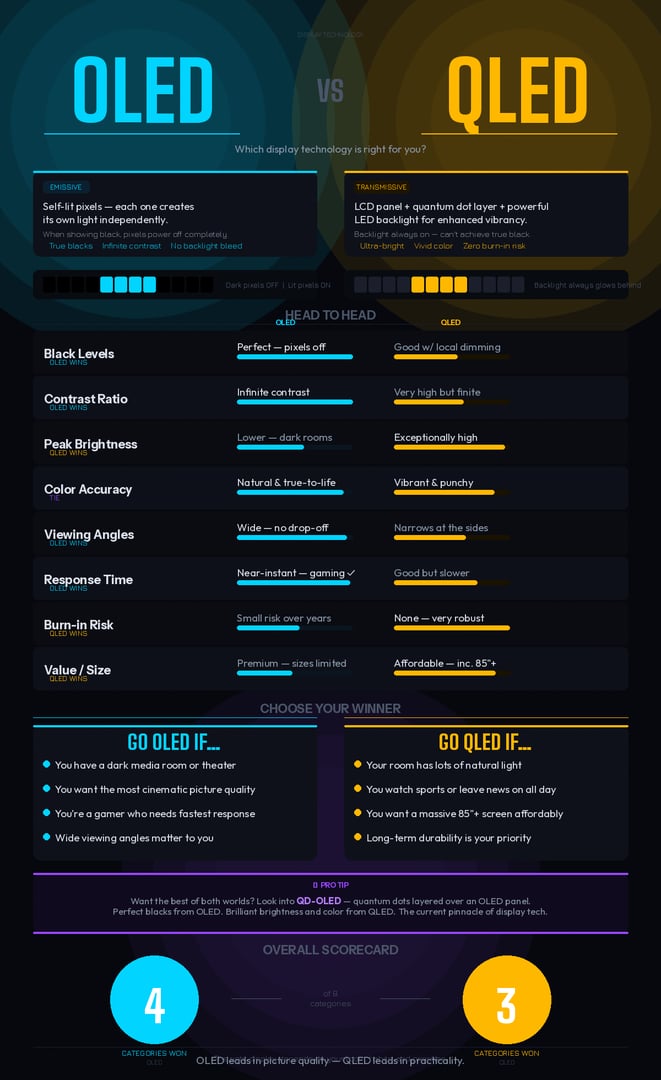
Which Display Is Right for You?
Based on how you'll use your TV
Movie Watching
If you watch movies in a dark room and want the best cinematic experience
Gaming
For competitive gaming with fast response times and minimal input lag
Bright Rooms
For rooms with lots of natural light where peak brightness matters
Sports & TV
Watching sports with friends in a bright environment
HDR Content
For Dolby Vision or HDR10 content with vibrant colors
Budget-Conscious
Looking for the best value without sacrificing quality
Detailed Specifications
A side-by-side breakdown of key performance metrics
| Feature | OLED | QLED |
|---|---|---|
| Black Levels | Perfect | Good |
| Contrast Ratio | Infinite | High |
| Peak Brightness | ~1,000 nits | 2,000+ nits |
| Color Accuracy | Excellent | Excellent |
| Response Time | 0.1ms | 2-8ms |
| Viewing Angles | Perfect | Good |
| Lifespan | ~100,000 hrs | Longer |
| Price Range | $$$$ Premium | $$ Moderate |
Important Note
Specifications may vary by manufacturer and model. These are general benchmarks for premium-tier displays.
Understanding the Core Differences
OLED and QNED use fundamentally different approaches to displaying images. Here's what sets them apart.
OLED
Organic Light Emitting Diode
OLED is "emissive": every single pixel creates its own light. When a pixel needs to show black, it simply turns off completely.
- Perfect Blacks & Infinite Contrast: Each pixel can be turned off completely
- Excellent Viewing Angles: Picture stays consistent even at extreme angles
- Near-Instant Response Time: Perfect for competitive gaming
The Catch: Risk of burn-in and lower peak brightness
QLED/QNED
Quantum Dot LED
QLED is "transmissive": a traditional LCD panel with a backlight and Quantum Dots that enhance color accuracy and brightness.
- Incredible Peak Brightness: Better for bright, sun-drenched rooms
- Vibrant, Saturated Colors: Quantum Dots produce punchy, vivid colors
- No Burn-In Risk: Robust panels, great for static content
The Catch: Struggles with "blooming" and can't achieve true blacks
Pro Tip: Consider QD-OLED
If you want the "best of both worlds," look into QD-OLED. It's a newer hybrid technology that uses Quantum Dots with an OLED panel to give you the perfect blacks of OLED with the improved brightness and color of QLED.
Our Verdict
Claim: "QNED is better than OLED"
Verdict: Mostly False
The claim that "QNED is better than OLED" is deemed mostly false based on the evidence reviewed. While QNED offers advantages in brightness and affordability, OLED technology consistently outperforms QNED in terms of contrast and black levels, which are critical for picture quality.
Key Findings
OLED Advantages
OLED displays generally outperform QNED in terms of contrast and black levels due to their ability to turn off individual pixels. This results in a more immersive viewing experience, especially in dark scenes.
QNED Advantages
QNED TVs are noted for their brightness levels, which can be advantageous in well-lit environments. They also tend to have a longer lifespan compared to OLEDs, which can suffer from burn-in issues.
Market Positioning
QNED is marketed as a more affordable alternative to OLED, aiming to provide high-quality visuals without the premium price tag associated with OLED technology.
Consumer Preferences
Consumer preferences vary based on usage scenarios. Gamers might prefer OLED for its fast response times, while viewers in bright rooms might lean towards QNED for its brightness capabilities.
It is important to note that the available evidence is limited, primarily relying on subjective assessments rather than comprehensive empirical studies. This limitation suggests that while OLED may generally be superior in picture quality, the assertion that QNED is categorically better lacks sufficient support.
Need Help Choosing a TV?
Our experts can help you find the perfect TV for your home and budget.
View Our TV ServicesReady to Get Your New TV Mounted?
Whether you choose OLED, QLED, or QD-OLED, our expert technicians ensure perfect installation every time.